Q1. What is E-Commerce? Explain its applications, advantages and disadvantages.
E-Commerce (Electronic Commerce) is any form of business transactions in which two or more organizations interact with each other electronically rather than physical exchange of documents or direct meeting.
It is commonly associated with buying and selling of information, products and services through the internet. It use the international networks of computers to create and transform the business relationships. It provides the business solutions that improves the quality of goods and services, increases the speed of service delivery to the customers and reduces the cost of business operations.
Advantages of E-Commerce
- Improve customer interaction.
- People can shop from home.
- Ease of access and global reach.
- Products sell at lower cost.
- 24 x 7 service available.
- Paperless exchange of business information.
- Low barrier to entry.
- Low cost of adverising medium.
- Competitive edge.
- Improved productivity.
Disadvantages of E-Commerce
- Security and legal Issues.
- Start up cost.
- Hardware and software requirement.
- Internet connection.
- Knowledge of computer.
- Inefficient customer service.
- Problem of trust on retailers i.e reliability.
- Late deliveries are driving people away from E-commerce.
Q2. Differentiate between electronic commerce and traditional commerce.
| S.N. | Electronic Commerce | Traditional Commerce |
|---|
| 1) | Scope is global. | Scope is local or regional. |
| 2) | Time required for business transaction is in terms of minutes. | Time required for business transaction is in terms of week. |
| 3) | Product attributes are selected by buyer. | Product attributes are selected by seller. |
| 4) | Prices are listed by taking overview of global market. | Prices are listed by taking overview of local market. |
| 5) | 24 x 7 service is available. | Generally, service is available between 9:00 am to 9:00 pm. |
| 6) | Paper work is less during transaction. | Lot of paper work during transaction. |
| 7) | Less time,high productivity and efficiency. | High time, less productivity and efficiency. |
| 8) | Knowledge of Computer, Internet and cyber law is necessary. | Knowledge of advanced technology is not necessary. |
Q3. Explain three pillars of E-Commerce with suitable diagram.
Three pillars of E-Commerce was developed by Peter Fingar. According to him E-Business is based on three pillars of E-Commerce model.The three electronic pillars support open market process.
The first piller: Electronic Information
Electronic Information in E-Commerce is all the data, content, and digital signals that are created, stored, processed, and exchanged electronically to support online business activities. It is the backbone of E-Commerce because every transaction, communication, and service depends on digital information rather than physical paperwork.
Importance in E-commerce
- Enables online transactions without physical interaction
- Helps in quick decision-making through real-time data
- Improves customer experience (personalization, recommendations)
- Supports inventory and supply chain management
- Reduces paperwork and operational costs
The second piller: Electronic Relationship
It is a central pillar. The electronic relationship is building a site that has the feeling of being a port of entry into a community. It maintains the relationship between the customers and online businessman who advertises through the internet.
Placing of the information or product advertises online, does not mean that the potential customers will visit the website first time and also the user will return to the site. Electronic relationship is key to successfully engaging in electronic commerce.
The third piller: Electronic Transaction
An electronic transaction is the exchange of money, goods, services, or information through electronic networks such as the internet, computers, or mobile devices — without the physical cash, paper, or face-to-face interaction.
Features of Electronic Transactions
- Paperless : No physical documents required
- Fast & Instant : Completed within seconds
- Convenient : Can be done anytime, anywhere
- Automated : Minimal human intervention
- Secure (if protected) : Uses encryption and authentication
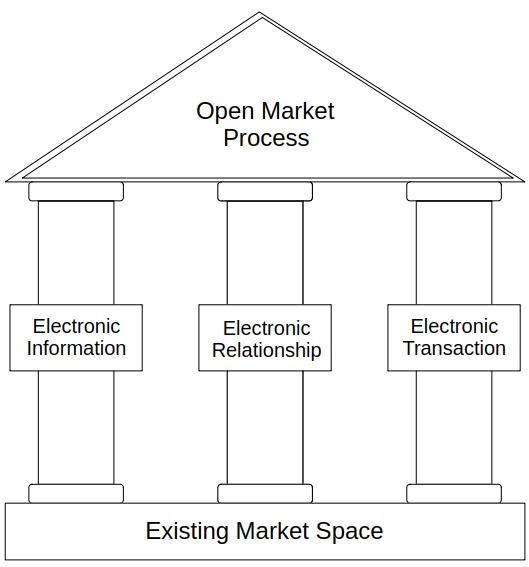
Fig. : Three Pillars of Electronic Commerce
Q4. Explain trade cycle of EDI.
The EDI trade cycle involves trading partners who wants to exchange data from the organizations. There may be two companies with a common customer or two banks whose customers wants to deal with one another or between two divisions of the same company, although if they have an integrated computer system, normally this would not be treated as EDI.
EDI is used for regular repeat transactions, it takes quite a lot of work to set up system to send and retrive EDI messages and, in general, it is not applicable to one-off exchanges,